
Romare Bearden, Baptism

Romare Bearden, Calabash

Paul Cezanne, Esquisse de Baigneurs
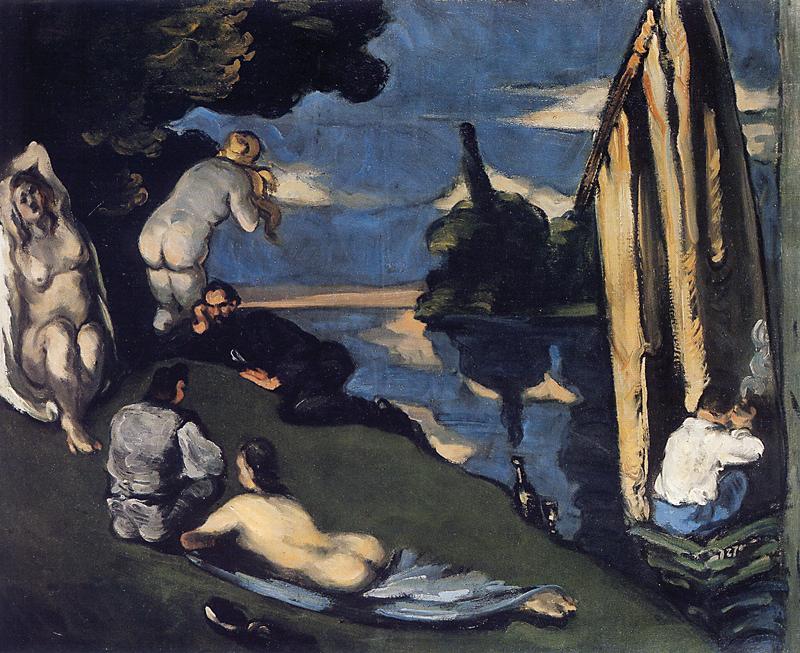
Paul Cezanne, Pastoral, or Idyll
I looked up these two artists in
reference to Blues Aubade (or Revision of
the Lean, Post-Modernist Pastorale). These are just four pieces from a
massive body of work by two very different artists. Honorée Fanonne Jeffers
doesn’t mention these pieces in particular but does refer to both Cèzanne and
Bearden in this poem, so I thought I’d look at some examples of their art and
include them here.
It’s
important that I’ve heard of Paul Cèzanne and not Romare Bearden. Cèzanne is a white
post-impressionist celebrated by the art world and Bearden is a black social
realist, also celebrated by the art world, but not ‘holy’ the way Cèzanne is. Bearden’s
‘collage of agrarian truths’ contrasts with Cèzanne’s pastorals, because it has
to work to be recognized. While comparisons to Cèzanne are inevitable, Honorée
has to hope space will be made for comparisons to Bearden:
“Before
I start meditating on the apples green buttock, / I hope there is time for a
second walk // to another field that breaks me down, for prayer / and work, the
precarious undoing of my birth.”
Black Pastoral is the title of the section that this poem
introduces, and one of the reasons I chose to include Cèzanne's Pastoral, or Idyll as an example of his work. Revising the pastoral is what Honorée intends to do, and I thought the similarities and differences between the bathers in Cézanne's work and the woman washing her feet in Bearden's show how the artists portray similar subject matter differently. Both artists were revolutionary in their own ways, but Cèzanne’s artistic revolution isn’t relevant
the way Bearden’s is, not for Honorée. While the Cèzanne’s of the world occupy
some ‘holy’ space of pastoral beauty and ‘fine art’, the Bearden’s of the world
break through with harsher realities of pastoral life. This poem, a self-titled
“Revision of the Lean, Modernist Pastoral”, considers the marginalization of
artists of color, who have to fight to be seen and heard. ‘Social realist’ (to
summarize Wikipedia) is the visual artist equivalent of a ‘political poet’. Being
willingly or unwillingly pigeon-holed into these categories is often the fate
of artists of color. Honorée expresses the frustration of writing a pastoral
reality in contrast with the white-dominated illusion of pastoral bliss.
Red Clay Suite is so firmly rooted in place,
even though the place is in-between. Especially I think in the first section Migration Cantos, which is a journey
from Oklahoma to Georgia, there’s a sense of being in-between. Physically in
transit between two places, but also (in Passing)
between two identities. Red clay grounds us to a region, not a state or a town,
but to something natural and malleable that lives in the memory of a place,
like clingstone peaches, collard greens, and the church rock that was ground up
into gravel.

Maggie,
ReplyDeleteI really appreciated the fact that you included images and throughly compared them in this post! The ways in which artists become known/idolized is always interesting to examine. In this case I think you do a great job when you bring us to how this relates to Jeffers as an author of color, fighting to escape labels that have been put upon her by society/the writing world.
I really think your ending to this post makes so much sense. I would even maybe argue that the art as well as the community of people inside this work (all of the names of authors and artists written to or from or for) are all "places" they are a sort of liminal space in which Jeffers can construct memory and story for readers.
Thanks!
Rai